Local energy dashboard - Rose Hill
LEMAP dashboard shows information about your postcode; including socio-economic and baselining data, such as annual energy demand; existing renewables and targeted dwellings for particular low carbon technologies.
OX4 4FG
6
100%
/
100%
/
6
Suitable for EV charger + battery
Suitable for EV charger
Electric vehicle (EV) charger
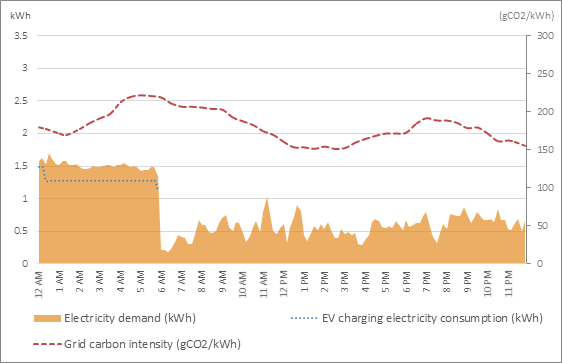
It is assumed that EVs travel an average of 32 km per day, consuming 0.20 kWh per km, resulting in a daily energy demand of 6.4 kWh/day.

6
100%
/
100%
/
6
Suitable for solar PVs
Suitable for PVs + battery
Number of dwellings / percentage of dwellings in the postcode
Photovoltaic panels (PV)
Dwellings potentially targeted for low carbon technologies
It is assumed that targeted dwellings have a PV system of 12 panels, an area if 19.2 m2, system efficiency of 0.15 ηpv, slope of 40° and south-oriented.
Home batteries of 5 kWh charged with surplus solar electricity set to discharge at 5 pm in the peak evening period.

5
/
83%
100%
/
6
83%
100%
/
/
5
6
Suitable for heat pump
Suitable for heat pump + battery
Ground source heat pumps
Air source heat pumps
Heat pumps
Dwellings suitable for GSHP required to be well insulated, at least double glazes, with garden and not being a mid-terrace house.
Dwellings suitable for ASHP required to be well insulated and at least double glazes.
.jpg)
Daily electricity profile
(Postcode's estimated typical electricity profile)

Heating season

Non-heating season
Daily electricity profile with battery
(Postcode's estimated typical electricity profile)

Heating season

Non-heating season
Daily electricity profile
(Postcode's estimated typical electricity profile)
Only showing heating season - as heat pumps do not represent a significant load during summer (non-heating season).

Heat pump energy profile
in heating season

Heat pump + battery energy profile
in heating season
Daily electricity profile
(Postcode's estimated typical electricity profile)

Heating season
Non-heating season
Daily electricity profile with battery
(Postcode's estimated typical electricity profile)

Heating season

Non-heating season
Dwelling age
Previous to 1870
1870-1919
1980-1999
2000-2009
2010-present
1920-1945
1946-1954
1955-1977
Number of dwellings
0
0
0
1
4
0
0
0
Built form
Detached
Semi-detached
Terraced
Flats
Domestic outbuilding
Number of dwellings
1
1
3
0
1
Home tenure
Owner occupied
Private renter
Social renter
Number of dwellings
4
0
0
Number of meters
6
6
2,379
kWh/year
Average energy consumption
7,364
kWh/year
Consumption change over 5 years
-6%
15%
Annual energy consumption
(2019 data)
Electricity
Gas
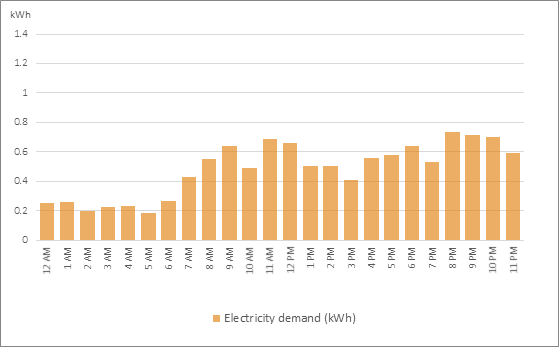
Daily electricity profile
(Postcode's estimated typical electricity profile)

Heating season
Non-heating season
Daily gas profile
(Postcode's estimated typical gas profile)

Heating season

Non-heating season
Percentage households in fuel poverty
Average annual household income
Average bedrooms per property
Average length of residency
Percentage households with children
50%
Over average
/
£25,000 - £29,999
3
9 years
17%
Solar PV
3
Private EV charger
0
Public EV charger
0
Existing energy resources
Number of dwellings or EV chargers
0
0
2
2
0
1
0
5
Distribution of EPC rating

A
C
D
E
B
F
G
No EPC
Energy performance certificate (EPC)
Domestic properties


Technical capability
Full potential
Partial potential
Need improvement
Unsuitable
2
3
1
4
Capability profile (dwellings per postcode):
Capability profile refers to the social and technical propensity of the household to take up low carbon technologies that can bring energy flexibility, such as solar PVs, batteries, heat pumps and EV chargers.
Digital capability
Hi-tech users
Tech savvy
Training required
Other priorities
Financial capability
Happy investors
Venturers
Penny savers
Deprived
Social capability
Fully convinced
Motivated
Skeptic
Not interested
0
9
1
0
0
6
4
0
0
0
8
2


Technical capability is the suitability of a dwelling in its location to take up low carbon technologies.
Full potential - capable of adopting all low carbon technologies.
Partial potential - capable of adopting some low carbon technologies.
Need improvement – capable of adopting technologies if relevant improvements are made to the dwellings.
Unsuitable - dwellings unsuitable for low carbon technologies, such as listed buildings.
Digital capability describes the engagement of a household in a dwelling with digital technology, including use of smartphones, computers, broadband, and level of digital engagement.
Hi-tech users – households with cutting-edge hardware (smartphones and computers) immersed in digital technology, which play a key role in the way they organise their life.
Tech Savvy – households composed of avid users of social media and smartphones that aspire to obtain cutting-edge hardware.
Training required - households that only use digital technology for entertainment, shopping or practical purposes, such as communicating with family and friends.
Other priorities - households with limited, little or no interest in digital technology, preference given to non-digital approaches.
Financial capability refers to a household’s ability to invest, take some level of financial risk or access capital or funding to deploy low carbon technologies or training.
Happy investors - households with ability to invest in low carbon technologies without looking for a financial return.
Venturers - households with access capital or funding to acquire low carbon technologies and expect some economic payback or delay of payments.
Penny savers - households that depend on loans, grants or programmes to implement low carbon technologies or change life patterns towards energy flexibility.
Deprived – socially or economically deprived households with priorities beyond low carbon technologies.
Social capability refers to the household’s motivation towards low carbon technologies, including the knowledge base, skills, and awareness to understand and value what these could bring to their lifestyle and the environment.
Fully convinced – households that prioritise activities towards the environment, usually have or are in process of implementing low carbon technologies.
Motivated - households with some interest and knowledge on the effect of flexible and low carbon technologies on the environment.
Skeptic - Households that need to be trained or guided to understand the benefits of implementing low carbon technologies or making changes in their lifestyle to flexible energy patterns.
Not interested - households with lifestyles that do not align with using low carbon technologies.
Spatial scale:
-
Rose Hill area - postcodes of Oxford by Rose Hill area agreed by the Smart and Fair committee.
-
Postcode - Geographical areas defined by the Royal Mail. The map represents 'Unit Postcodes' (Level 4), which is the smallest level of representation.
Data layers and sources:
-
Dwellings’ type – Most common dwelling form and dwelling age in the postcode. [Geomni:2021; Mosaic:2020; EPC:2021].
-
Bedroom count – Mean number of bedrooms and habitable rooms [Geomni:2021; Mosaic:2020].
-
Length of residency – Mean number of years a household occupies a property [Mosaic:2020].
-
Electricity consumption - Annual electricity consumption of domestic properties by area. [BEIS:2019]
-
Gas consumption - Annual gas consumption of domestic properties by area. [BEIS:2019]
-
Energy change – Differential consumption rate between the registered data of 2015 and 2019. [BEIS:2019]
-
EPC (domestic & non domestic)— shows the energy efficiency rating of assessed properties [Ministry of Housing, Communities & Local Government:2019]
-
Domestic fuel poverty – The probability of a household having fuel poverty by postcode and its relation to the fuel mean fuel poverty in Rose Hill area. A household where fuel costs are above the national median level; were they to spend that amount, they would be left with a residual income below the official poverty line. [Mosaic:2020].
-
Household income – shows the net household income, taking into account tax, national insurance, council tax and the household size and composition. [Mosaic:2020]
-
Probability of households with children – shows the mean probability of households to have children up to 11 years old in the area. [Mosaic:2020]
-
Dwellings with PV - shows domestic properties with PV systems installed by postcode. [ERIC project]
-
Public EV chargers — shows public Electric Vehicle (EV) charging points available in the area. [National charge point registry]
-
Domestic EV chargers – shows the number of private domestic chargers by postcode. [BEIS:2018]
Energy profile data layers:
-
Electricity demand – shows the daily mean dwelling electricity demand including LCTs electrical loads.
-
PV electricity generation – shows the daily mean PVs electricity production.
-
Heat pump electrical load – shows the daily mean proportion of electricity demand corresponding to heat pump electrical load (only heating season).
-
EV charging electricity consumption – shows the daily mean proportion of electricity demand corresponding to EV charging. Charging hours are set to 12-5am in relation to time-of-use tariffs.
-
Self-consumption of PV – shows the daily mean electricity consumed directly from PVs.
-
Battery discharge - shows the mean daily electricity discharge from the home battery.
-
Total net electricity demand with HP - shows the mean daily electricity consumption of all the dwellings in the area with heat pumps in the heating season
-
Grid carbon intensity – National measurement of how much CO2 emissions are produced per kilowatt hour of electricity consumed (gCO2/kWh).
Notes:.
-
Energy profiles were created using archetypes for that neighborhood. They are modelled using a modified CREST model and not actual energy demand profiles for individual dwellings.